MAUSOLEUM OF KHOJA AHMED YASAWI
MAUSOLEUM OF KHOJA AHMED YASAWI
The Mausoleum of Khoja Ahmed Yasawi is a famous medieval monument in Central Asia. During the Soviet period, it was revered as a “second Hajj.” It is included in the UNESCO World Heritage List and is considered one of the most significant historical and architectural monuments in modern Kazakhstan.
The first structure over the saint’s grave was built in the 12th century, as confirmed by decorative fragments discovered by archaeologists and preserved in the Turkestan museum. Later, the mausoleum constructed by Amir Timur continues to demonstrate the power of the great ruler through its architectural design. There are several interpretations of the purpose of its construction. One view suggests that it was built to subdue semi-obedient nomadic tribes along the Syr Darya. By honoring their sacred places, it was possible to gain their trust and loyalty. It also served as a symbol of spiritual unity among Muslim peoples and demonstrated imperial power through large-scale construction. These were the practical purposes behind the construction of this unique architectural monument at the end of the 14th century.The history of the construction of this historical monument is interpreted in connection with the name of the great Sahibqiran Amir Temur. According to legend, when entering the city of Sayram, Amir Temur would dismount from his horse and enter on foot. Here, the respect of the world-renowned commander for Ahmad Yasawi–known in the Turkic world as Hazrat Sultan and regarded as the “sheikh of sheikhs”–is reflected. According to historical sources, Amir Temur stopped in the city of Sayram in 1389, 1391, 1394, and 1405.
One of the important historical sources describing the activities of Sahibqiran Amir Temur, the “Zafarnama,” connects the beginning of the construction of the mausoleum with events related to the end of the year 799 Hijri, that is, the autumn of 1397 CE. Amir Temur, who had set out to meet Tukal Khanim, the daughter of Khizr Khoja Khan, the ruler of Moghulistan, settled for winter near Ohangaron, close to the village of Chinoz. In September, he went to the city of Yassi and solemnly performed the ceremony of visiting the grave of Khoja Ahmad. After the visit, the amir rewarded the people living around the cemetery and some nearby individuals with gifts and charitable donations. Amir Temur never again returned to the city of Yassi. In 1405, when he was once again on the banks of the Syr Darya, his life ended in February in the city of Otrar. This city was located 50 kilometers south of the place where Khoja Ahmad’s grave is situated.
According to the information recorded in the “Zafarnama,” it was precisely when Amir Temur was in the city of Yassi that he issued a decree to build a new mausoleum over the sheikh’s grave. The decree described in detail the overall architectural plan of the mausoleum, its main dimensions, and even aspects of its decoration and interior design. The diameter of the main dome was set at forty-one gaz, and this measurement determined all other proportions of the mausoleum. At the front, a tall arched portal with two minarets was planned. Behind it, a large domed rectangular chamber with each side measuring thirty gaz was to be placed. In the center of the chamber, a basin (khauz) cast from an alloy of seven metals, shaped like door handles, was to be installed. Further inside, there was another chamber with each side measuring twelve gaz, located under a smaller dome, within which was the sheikh’s grave covered with marble brought from Tabriz.
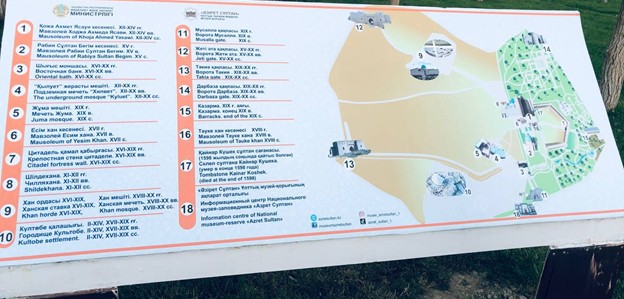
When discussing other sacred places visited within the Khoja Ahmad Yasawi architectural complex, special emphasis should be placed on the underground mosque known as the chillakhona and khalvat, located approximately 100 meters southwest of the mausoleum. About one kilometer from the chillakhona is the “Kumshik Ota” shrine. It was a small brick structure, and an underground passage led to it from the chillakhona. Khoja Ahmad Yasawi came here to perform dhikr.
The epigraphic materials preserved in various parts of the mausoleum have conveyed to us the names of Persian craftsmen who participated in its construction, as recorded on certain decorative elements. The year 797 Hijri (1394/1395 CE), indicated on the hinge of one of the interior doors, suggests that construction may have begun several years earlier than the autumn of 1397.
The name of a craftsman from Shiraz, Khoji Hasan, and the date 800 Hijri (1397-1398 CE) are inscribed in blue bricks on the outer part of the northern portal. On a hexagonal tile located on the drum of the small ribbed dome, the name of another craftsman from Shiraz–Shams Abdul-Wahhab–has been preserved. The construction of the multi-chambered mausoleum with a complex composition was halted in 1405 after the death of Amir Temur. The entrance portal remained unfinished and was completed during the reign of the Bukhara ruler Abdullah Khan II in 1583.
The unified plan of the complex was based on a strictly standardized unit of measurement–the gaz, equal to 60 cm. The Khoja Ahmad Yasawi memorial complex is considered one of the largest monuments in Central Asia both in terms of its absolute size and scale, as well as its architectural and artistic significance. Sahibqiran Amir Temur endowed the mausoleum with surrounding agricultural lands, gardens, irrigation structures, a two-ton cauldron (doshqozon), six candlesticks, and door handles. A craftsman from Isfahan, Izz al-Din, son of Taj al-Din, produced bronze hinges decorated with silver for two doors, as well as several elegant bronze candlesticks. The bronze candlesticks, prepared by special order of Amir Temur, were completed on the 20th day of Ramadan in the year 799 Hijri, that is, June 17, 1397. The large bronze cauldron was cast by a master from Tabriz, Abdul-Aziz, son of Sarvar al-Din.
The doshqozon, located in the center of the main hall, is a massive water vessel with a diameter of nearly 3 meters and a weight of about two tons, symbolizing prosperity and hospitality for nomadic peoples. Its surface is decorated with three bands of relief inscriptions against a background of plant motifs. According to the inscriptions, the cauldron was made in 1397-by order of Amir Temur in honor of Khoja Ahmad Yasawi.
Due to the atheist policies of the Soviet period, the sheikhs who had been active at the mausoleum were persecuted, and the neglected monument fell into ruin. In 1936, by government decision, the doshqozon was sent to Leningrad (now Saint Petersburg) to participate in an international exhibition at the Hermitage Museum. There were plans to include this unique artifact permanently in the Hermitage collection. However, due to demands from the local population, the doshqozon was returned to Turkestan only after 54 years – on September 18, 1989-and reinstalled in its original place, the communal hall. Two candlesticks, however, are preserved today in the Louvre and the Hermitage museums. In the service rooms of the mausoleum, ancient hearths, cauldrons, and wooden utensils used by pilgrims for meals have been preserved as museum exhibits.
M. E. Masson, upon seeing the mausoleum and its grandeur, was astonished and referred to it as the “Hagia Sophia of Central Asia”. The power of this famous mausoleum lies in its unique architectural form, its external and internal decorations, as well as the numerous medieval artifacts, the legends and traditions preserved in popular belief to this day, and the faith and devotion to Khoja Ahmad Yasawi, regarded as the Sultan of Saints.
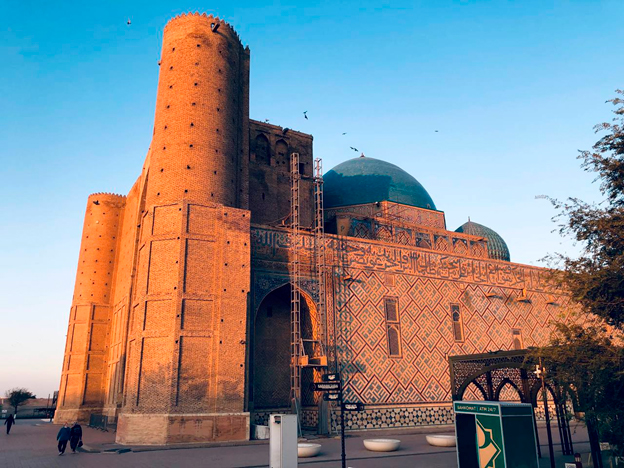
Another distinctive feature of this historical monument is that, unlike other structures built during the era of Amir Temur and the Timurids, buildings such as the burial chamber (gurkhona), mosque, and halimkhona are combined under a single dome – an architectural approach that is rare in medieval architecture.
Historical places
Our native land is full of history !
MAUSOLEUM OF ARYSTAN BAB
TurkestanIn 1376, following the transfer of Otrar under the authority of Amir Timur, the mausoleum of Arystan Bab was constructed by his order. Arystan Bab occupies a special place in th...
MAUSOLEUM OF KHOJA AHMED YASAWI
TurkestanThe Mausoleum of Khoja Ahmed Yasawi is a famous medieval monument in Central Asia. During the Soviet period, it was revered as a “second Hajj.” It is included in the UNESCO...
MAUSOLEUM OF RABIA SULTAN BEGIM
TurkestanThe Mausoleum of Rabia Sultan Begim is a 15th-century architectural monument located in Turkestan. Rabia Sultan Begim was the daughter of the great scholar-astronomer and ruler...
GAUKHAR ANA – A HOLY MOTHER AND A HEALING SOURCE OF FAITH
TurkestanIn southern Kazakhstan, not far from Turkestan, lies the mausoleum of Gaukhar Ana –the daughter of the great Sufi master Khoja Ahmed Yasawi. Gifted with healing abilities, sh...
THE BABA-ATA MOSQUE-MAUSOLEUM
TurkestanThe Baba-Ata mosque-mausoleum (Kazakh: Baba ata meshit-kesenesi) is an architectural monument located in the village of Babaata in the Suzak District of the Turkestan Region, o...
DOMALAK-ANA MAUSOLEUM
TurkestanDomalak-Ana Mausoleum (Kazakh: Domalaq ana kesenesi) is an architectural monument located in the Baidibek District of the Turkestan Region of Kazakhstan. It lies 2 km south of ...
IBRAHIM ATA
TurkestanThe Ibrahim Ata Mausoleum is an architectural monument located in the South Kazakhstan region. It stands on the outskirts of the northwestern part of the village of Sairam, on a...
KARASHASH-ANA MAUSOLEUM
Turkestanp class="text_indent">In the ancient village of Sayram, which today is a neighborhood in the eastern part of Shymkent, stands one of the most revered monuments of South Kazakhstan – the Mausoleum of...