MAUSOLEUM OF RABIA SULTAN BEGIM
MAUSOLEUM OF RABIA SULTAN BEGIM
The Mausoleum of Rabia Sultan Begim is a 15th-century architectural monument located in Turkestan. Rabia Sultan Begim was the daughter of the great scholar-astronomer and ruler Ulugh Beg and was married in 1451 to Abulkhair Khan. She was the mother of Abulkhair Khan’s younger sons – Kuchkunji Khan and Suyunchkhoja Khan. Rabia lived in Turkestan and died there in 1485. The mausoleum was built by decree of her eldest son, Kuchkunji Khan.
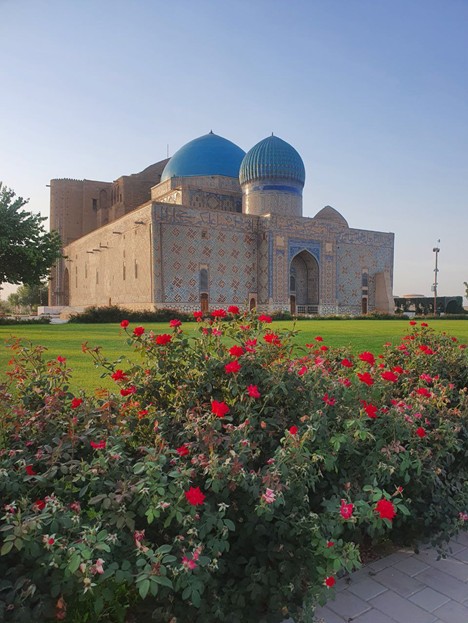
This octagonal, portal-domed mausoleum continues the architectural traditions of the Timurid period. In 1896, the structure deteriorated and was completely demolished, and its ruins were leveled. In 1952, 1954, and 1957, excavations revealed walls up to 3 meters high and a large sarcophagus beneath the floor. Between 1960 and 1963, due to neglect, the remaining parts were dismantled for bricks. The mausoleum was reconstructed in 1980. Despite being Abulkhair Khan’s fourth wife, Rabia Sultan Begim was recognized among the people as his principal wife.The mausoleum was built in an Eastern architectural style. Its central part is cylindrical and covered with a dome. The internal layout consists of five chambers: a central octagonal hall and four side rooms. The mausoleum is located 60 meters southeast of the Khoja Ahmad Yasawi mausoleum and is considered a monument of national importance. Its portal is shaped like a tall pointed arch, with a height of 20.6 meters and a width of 11 meters. The arch span is 6 meters, and the distance between the side walls is 3.5 meters. The central section is covered with a dome set on a high cylindrical drum. Other facades feature five pointed niches each.
The monument has reached us in a heavily ruined condition. Archaeological research has uncovered numerous fragments of majolica and glazed ceramics, indicating that the building was once covered with colorful ceramic decoration. The first scientific study was conducted in 1954 by K. A. Shakhurin. In the early 1980s, the mausoleum was fully restored. In 1994, it was included in the list of historical and cultural monuments of the South Kazakhstan region and placed under state protection.
Rabia Sultan Begim Mausoleum is located 60 meters southeast of the Khoja Ahmed Yasawi mausoleum and is considered a monument of national significance. Rabia Sultan Begim, a representative of the Timurid dynasty, was the daughter of Ulugh Beg and the granddaughter of Amir Temur. She was the wife of Abulkhair Khan of the Shaybanid dynasty and the mother of Kuchkunji Khan and Suyunchkhoja Khan. After the death of Abulkhair Khan, Rabia Sultan Begim lived for another 17 years in Turkestan and died there. She was buried in a specially constructed mausoleum alongside her grandson and three great-grandchildren. An inscription preserved on the dome reads:
“This is the resting place of the noble and righteous Rabia Sultan Begim, daughter of the powerful and great Sultan Ulugh Beg Guragani, who died as a martyr. He, in turn, was the son of the powerful Amir Temur Guragan. May God fill all their graves with light until the Day of Judgment…”
The facade of the mausoleum is designed as a tall spear-shaped portal. Its height reaches 20.6 meters and width 11 meters. The arch span is 6 meters, and the distance between the side walls is 3.5 meters. The central part is covered with a dome set on a high cylindrical drum. The architectural structure consists of five chambers: a central octagonal hall and four side rooms. The remaining facades feature five pointed niches each.
The monument has come down to us in a severely ruined state. Archaeological excavations uncovered numerous fragments of majolica and glazed tiles, indicating that the structure was once entirely decorated with colorful ceramic coverings. The first scientific study was carried out in 1954 by K. A. Shakhurin. In the early 1980s, the mausoleum was fully restored. In 1994, it was included in the “Collection of Historical and Cultural Monuments of Kazakhstan” under number 590.6 and placed under state protection.
According to historical sources, Ulugh Beg had five wives and thirteen concubines, and from them he had ten sons and ten daughters. Abd al-Latif was his tenth son, who later opposed him. Abd al-Latif and his sisters Sultan Bakht, Aq Bosh, and Rabia Sultan Begim were born to Ruqiya Khatun (Sultan), daughter of the leader of the Orlat tribe. Ruqiya was not Ulugh Beg’s official wife but his first concubine. Therefore, her children were raised under the care of Ulugh Beg’s father Shah Rukh and his principal wife Gawhar Shad. Since Rabia was the youngest daughter, she was likely especially loved and raised like their own child. This may explain why her name does not appear in official Timurid genealogies or lists of Ulugh Beg’s daughters. However, sources such as “Tarikh-i Abulkhair-khani” and “Sharaf-name-yi Shahi” mention her as the daughter of Ulugh Beg.
Abulkhair Khan and Rabia Sultan Begim were married in 1451. At that time, the khan was 39 years old, while Rabia was approximately between 26 and 30. Abulkhair Khan died in 1469 at the age of 57, and Rabia lived for another 17 years, passing away around the age of 60 in 1485.Their sons, Kuchkunji Khan and Suyunchkhoja Khan, held important state positions during their time. In 1508, when Muhammad Shaybani Khan arrived in Bukhara, he distributed territories among his relatives: Kuchkunji Khan was appointed to govern Turkestan and its surrounding areas, while Suyunchkhoja Khan was assigned to rule Tashkent.
After Shaybani Khan’s death in 1510, the state was ruled for the next twenty years by his cousins, Suyunchkhoja Khan and Kuchkunji Khan. Kuchkunji resided in Bukhara, while Suyunchkhoja ruled over Tashkent and Turkestan.
Rabia Sultan Begim died in 1485. Her son Suyunchkhoja Khan passed away in 1525, and his son, Keldi Muhammad Sultan, died between 1529 and 1533. Keldi Muhammad’s sons – Qul Muhammad Sultan (d. 1523) and Mubarak Shah Sultan (d. 1519) – as well as his daughter Mastura Khanim (d. 1519), died at a young age and were buried in Turkestan.Except for Suyunchkhoja Khan, all of them were buried in the mausoleum of Rabia Sultan Begim. Archaeological excavations carried out by Uzbek specialists between 1951 and 1957 revealed the remains of a man and a woman buried side by side, as well as the remains of three children between them. These children most likely died in infancy, as their grandfather Suyunchkhoja Khan outlived them.
Among the children, the eldest was probably Mastura, since the title “Khanim” was typically given to married women, and in that period girls were often married at the age of 9–10. For example, Ulugh Beg himself married Uka Begim at the age of 10. Some researchers (A.A. Semyonov and L.Yu. Mankovskaya) claim that Rabia spent her entire life in Turkestan; however, this view is likely incorrect. In the work Tarikh-i Abulkhair Khani, it is emphasized that Rabia enjoyed great respect among the people under Abulkhair Khan’s rule and among his relatives. She actively participated in political life and state affairs.In certain historical sources, Rabia Sultan is compared to the wise Queen of Sheba – Bilqis known from Biblical traditions.
Historical places
Our native land is full of history !
MAUSOLEUM OF ARYSTAN BAB
TurkestanIn 1376, following the transfer of Otrar under the authority of Amir Timur, the mausoleum of Arystan Bab was constructed by his order. Arystan Bab occupies a special place in th...
MAUSOLEUM OF KHOJA AHMED YASAWI
TurkestanThe Mausoleum of Khoja Ahmed Yasawi is a famous medieval monument in Central Asia. During the Soviet period, it was revered as a “second Hajj.” It is included in the UNESCO...
MAUSOLEUM OF RABIA SULTAN BEGIM
TurkestanThe Mausoleum of Rabia Sultan Begim is a 15th-century architectural monument located in Turkestan. Rabia Sultan Begim was the daughter of the great scholar-astronomer and ruler...
GAUKHAR ANA – A HOLY MOTHER AND A HEALING SOURCE OF FAITH
TurkestanIn southern Kazakhstan, not far from Turkestan, lies the mausoleum of Gaukhar Ana –the daughter of the great Sufi master Khoja Ahmed Yasawi. Gifted with healing abilities, sh...
THE BABA-ATA MOSQUE-MAUSOLEUM
TurkestanThe Baba-Ata mosque-mausoleum (Kazakh: Baba ata meshit-kesenesi) is an architectural monument located in the village of Babaata in the Suzak District of the Turkestan Region, o...
DOMALAK-ANA MAUSOLEUM
TurkestanDomalak-Ana Mausoleum (Kazakh: Domalaq ana kesenesi) is an architectural monument located in the Baidibek District of the Turkestan Region of Kazakhstan. It lies 2 km south of ...
IBRAHIM ATA
TurkestanThe Ibrahim Ata Mausoleum is an architectural monument located in the South Kazakhstan region. It stands on the outskirts of the northwestern part of the village of Sairam, on a...
KARASHASH-ANA MAUSOLEUM
Turkestanp class="text_indent">In the ancient village of Sayram, which today is a neighborhood in the eastern part of Shymkent, stands one of the most revered monuments of South Kazakhstan – the Mausoleum of...